
About This Holiday Lighting Guide
Prepared by: Holiday Illumination Christmas Light Installation
Last updated: October 24, 2026
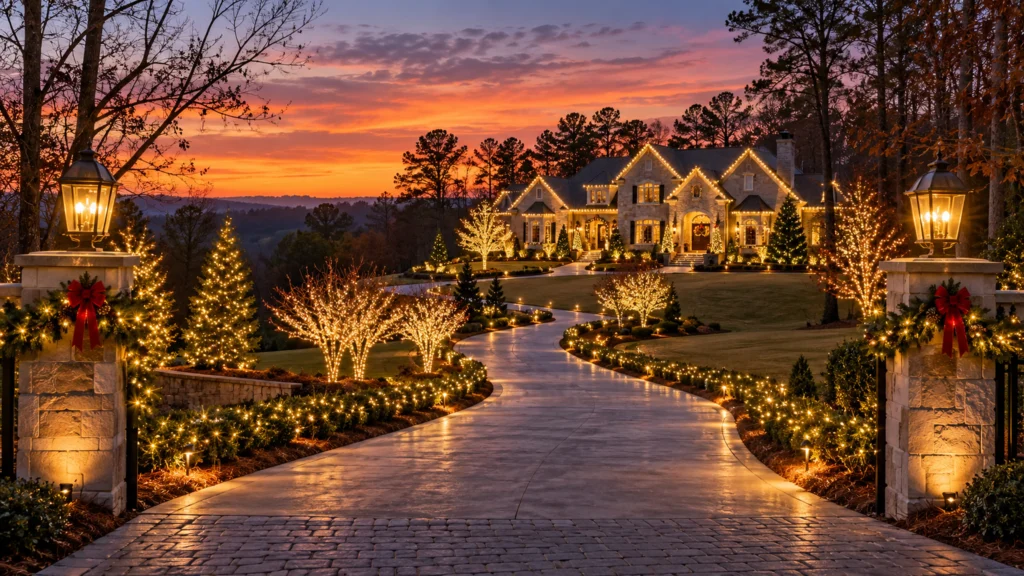
A long driveway Christmas light design in Atlanta should guide the eye through a sequence of spaces, not scatter lights across every acre of landscaping. On properties set far back from the road, close-up decorations may disappear from the street. The challenge is deciding where a visitor should first notice the display and how the impression changes while approaching the home.
Think in three distances: road view, driveway midpoint, and arrival at the front entrance. Each location reveals a different amount of detail. A coherent outdoor Christmas lighting plan can connect the house, selected trees, and driveway edges without turning the property into several unrelated displays.
Define the main viewing route
Drive down the approach at normal low speed and note the first moment the house becomes visible. Trees, curves, gates, and changes in elevation may hide the facade until the final portion of the driveway. The most useful focal feature may therefore be an entrance tree or gate-side planting rather than a distant rooftop.
Make photographs at safe stopped locations rather than while driving. Compare how the property reads in daylight and after sunset. Mark the point at which visitors need to recognize the driveway entrance and the point where the house becomes the visual destination.
Choose a small number of landmark features
A large front yard benefits from hierarchy. One prominent tree near the entrance, a consistent house outline, and an entry accent can create a clear sequence. Lighting five unrelated trees may create more sparkle but less direction. Use repeated colors and a consistent spacing style so separate zones still appear to belong to one design.
A purposeful tree-wrapping plan can establish a landmark without requiring every trunk on the property to be decorated. Consider whether trees are visible from the public road or only from inside the grounds before committing to their coverage.
Make the distant house silhouette readable
At long viewing distances, small wreaths and narrow window outlines may merge into the background. Major roof edges and large vertical elements read more clearly. Start with the front-facing roof geometry, then decide whether any secondary details remain visible from the approach.
The roofline installation resource is helpful for understanding how roof pitch, ridges, gutters, and access affect the actual outline. An expansive roof does not necessarily need complete coverage; the portions visible on arrival should be the priority.
Use driveway accents sparingly
Decorative accents along an entire long driveway can demand extensive material, complex routing, and ongoing upkeep. A better approach may mark an entrance, a curve, or the final arrival zone rather than following every foot of pavement. Avoid anything that reduces driver sightlines or places cords across vehicle paths.
Existing landscape fixtures already help define the driveway. Check whether the holiday plan should complement those lights rather than duplicate their function. Decorative lighting should never replace required visibility at gates, changes in grade, or pedestrian crossings.
Respect irrigation, distance and terrain
Long properties can have drainage ditches, uneven ground, sprinklers, retaining walls, and remote planting beds. The distance from suitable power sources changes the installation scope; do not assume a single extension cord can safely serve a far-off decorative zone. Connection locations and electrical capacity must be assessed for the actual layout.
If the property includes steep or muddy slopes, review how crews will access and later remove decorations. Weather and ground conditions can influence the feasible design and installation timing.
Create a consistent color and density plan
A large site can absorb more light, but inconsistent palettes across zones make it look fragmented. Choose one dominant roofline or landscape color family and decide whether a second accent color has a specific role. Repetition is especially useful when displays are separated by several hundred feet of landscape.
Before specifying materials, compare your intended palette with the color-selection guide. Similar product descriptions can still produce visibly different whites or brightness, which becomes obvious when visitors approach from a distance.
Ask for separate zone pricing
Divide the proposal into driveway entrance, approach landscape, house outline, and arrival courtyard or porch. Mark must-have and optional areas. That lets the customer reduce scope without losing the main visual sequence. The installation cost guide explains why access, complexity, materials, and seasonal responsibilities matter more than one generic price per foot.
A useful quote identifies the power and maintenance approach for each zone. If one area fails during the season, the owner should know whom to contact and whether the other zones can continue operating independently.
Frequently asked large-property questions
Do I need lights for the entire length of the driveway?
No. Entrance landmarks, a selected curve, and a strong arrival scene can create continuity without lighting every stretch of pavement.
Why do small decorations disappear on large lots?
Viewing distance reduces visible detail. Larger rooflines, clear tree silhouettes, and repeated colors generally communicate better from far away than many tiny accents.
Can the display be built in phases?
Yes. Define a complete visual core first, then treat additional landscape zones as optional phases with their own access and maintenance considerations.
Plan the full approach experience
Share a property map or aerial screenshot, driveway photos, visible power locations, and the desired focal zones through the Holiday Illumination estimate page. The aim is a memorable arrival, not maximum coverage of unused space.