
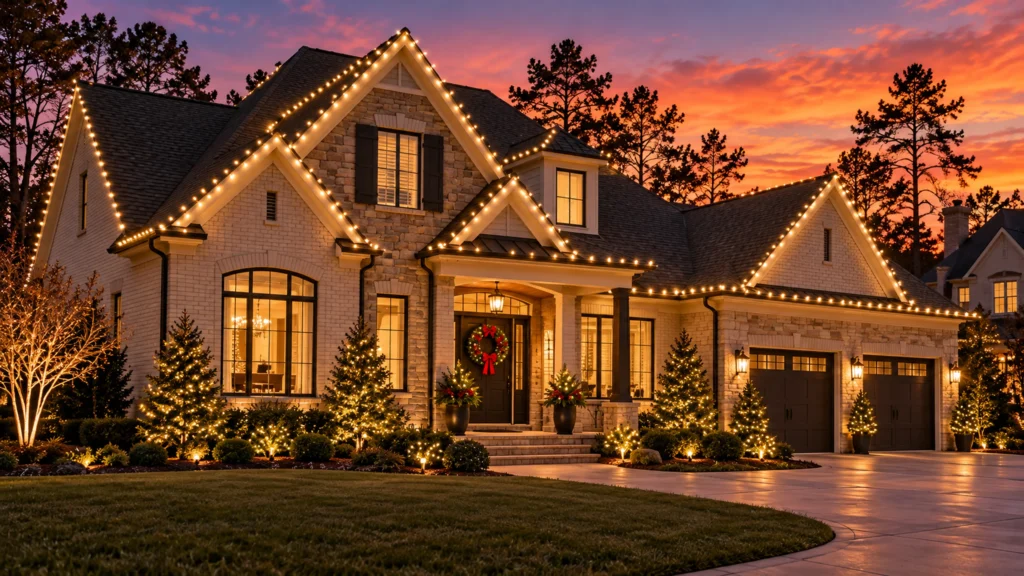
About This Holiday Lighting Guide
Prepared by: Holiday Illumination Christmas Light Installation
Last updated: October 25, 2026
For busy families, low-maintenance Christmas lights in Atlanta are less about minimizing the number of bulbs and more about reducing the number of decisions and interruptions throughout the season. The right display should be easy to operate, simple to understand if a section stops working, and straightforward to remove when the holidays end.
A good plan starts with a small set of visible features and a clear service agreement. Professional residential lighting can be scoped around a primary roofline, an entrance accent, and perhaps one landscape feature instead of a complicated layout that demands constant attention.
Favor a few cohesive lighting zones
Separate the property into obvious zones: roofline, entrance, and landscape. A simple plan makes it easier to identify which part of the display needs attention without guessing where every strand begins and ends. It also helps prevent decorative wiring from sprawling through unused areas of the yard.
Prioritize what people see most often. A well-lit front elevation may create a better everyday experience than a complex backyard installation that few guests notice. When a zone does not add meaningful value, leave it out rather than including it by default.
Make switching the lights on routine
Choose a predictable evening schedule suitable for your household, neighbors, and any community rules. Ask how the proposed controller or timer will be operated and whether adjustments are needed during the season. Automation is helpful only when the installed device and setup are appropriate for outdoor use and household electrical conditions.
Make sure another adult in the household knows how the system is supposed to work. A written note showing the operating schedule and installer contact is more useful than relying on one person’s memory in the middle of a busy holiday week.
Reduce opportunities for avoidable faults
More separate decorative elements can mean more connections and more places to inspect. Plan sensible cable routes, suitable outdoor-rated equipment, and protected access around doors and walkways. Do not conceal damaged wiring with decorations or rely on improvised electrical fixes to keep the lights running.
The site’s LED lighting comparison explains why product choice, efficiency, and outdoor performance should be considered as part of the plan. The exact components and electrical arrangement still need to be appropriate for the property.
Define how maintenance requests work
A low-maintenance display needs a clear support process. Before installation, ask what qualifies as an in-season issue, how to report a dark section, and which parts of the installed display are covered. Photograph the main zones once they are working so a future service request can identify the location quickly.
Holiday Illumination describes in-season maintenance and repair. The proposal should specify the terms that apply to the particular project rather than assuming every possible problem has the same response or coverage.
Plan around travel and holiday guests
Families may travel for several days or host gatherings on fixed dates. Communicate those dates when requesting the installation and choose a practical operating plan while the property is unoccupied. Do not depend on someone making daily manual adjustments that they are unlikely to remember.
If the entrance will receive more foot traffic during parties, keep decorated railings, cords, and steps clear. The easiest display to live with is one that does not interfere with normal arrivals, deliveries, or the household’s schedule.
Include removal and storage from the beginning
End-of-season handling can be the biggest time-saving part of a professional plan. Confirm whether removal is included, how scheduling is coordinated, and whether optional storage is available. Labeling components by zone can simplify next year’s planning and reduce the chance that different sets are mixed together.
The post-holiday removal service is worth discussing during the original estimate, not after the display has already been installed. A clear handoff avoids last-minute questions about who is responsible for what.
Keep next year’s decision simple
After the season, note what worked: the brightness, installation timing, main focal points, and any zones that felt unnecessary. One short checklist is often enough to make next year’s design approval faster. Consistency can be valuable, but it does not require repeating a feature that proved difficult or visually unhelpful.
Use the site’s full-season service guide to understand which responsibilities should be documented in the agreement. The goal is predictable service, not a promise that outdoor lighting never needs attention.
Frequently asked low-maintenance questions
Is a smaller display always easier to maintain?
Often it has fewer components, but equipment choice, access, connection placement, and maintenance support matter too. A well-planned larger display can be simpler to operate than a messy small one.
Can I schedule lights without a daily manual switch?
Usually a suitable timer or controller can provide predictable operation when it is correctly chosen and installed for the equipment. Confirm device compatibility and settings.
Does professional installation eliminate all service issues?
No. Outdoor systems can still be affected by component failure and weather. Good service planning defines what happens when attention is needed.
Make the holiday season easier
Describe your preferred operating hours, travel dates, must-have display areas, and storage preferences when requesting a Holiday Illumination quote. A practical low-maintenance display should support your routine instead of becoming another seasonal chore.