
About This Holiday Lighting Guide
Prepared by: Holiday Illumination Christmas Light Installation
Last updated: October 17, 2026
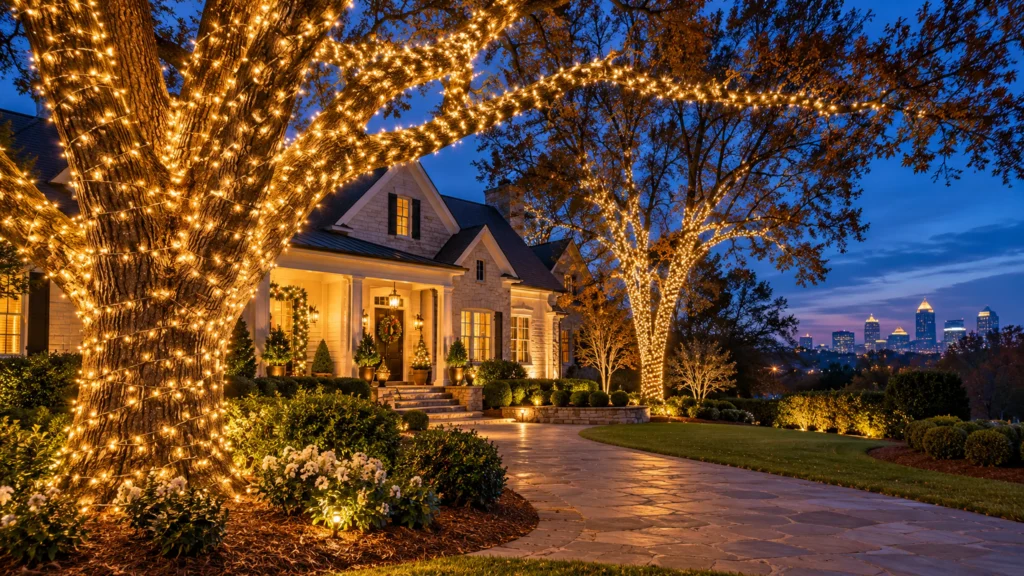
Tree-wrapping Christmas lights in Atlanta can make a front yard feel dimensional even when the house itself uses a very restrained display. The effect depends less on wrapping every available tree and more on choosing the right trunk, height, spacing, and viewing angle. A strong tree treatment creates a focal point that supports the house rather than overpowering it.
Before selecting a pattern, walk the property from the curb and driveway. Look at which trunks are visible, which branches cross in front of the house, and where shrubs or parked vehicles block the view. The tree-wrapping service overview explains how landscape accents can complement rooflines and entries as part of a coordinated outdoor plan.
Choose one focal tree before lighting a group
A single tree with an attractive trunk and branching structure often creates a cleaner first impression than four unrelated wraps. Tall trees may be prominent from the street but require careful assessment of reachable sections and attachment methods. A medium-height ornamental tree near the main walkway can sometimes deliver a stronger effect because its shape is easy to read from close and far away.
Group lighting works best when the trees have a clear relationship: matching specimens along the driveway, a pair framing the approach, or several trunks in one planting bed. If tree sizes vary widely, use a repeated visual rule—such as consistent trunk illumination—rather than forcing exactly the same number of lights onto each.
Match the wrapping pattern to the trunk and branches
Spiral trunk wrapping draws attention vertically; selective lower-branch wrapping produces more of a branching silhouette. A closely spaced spiral can look intense up close and crowded from the road. Wider, even spacing may feel more elegant on larger trunks. The right pattern depends on bark texture, branching points, natural movement, and how the tree appears after leaves fall.
Avoid wrapping so tightly that wiring restricts growth or rubs against sensitive bark. Installation hardware should be appropriate for outdoor tree applications, with connections planned for weather exposure. Living trees change during the season, so a service plan should allow appropriate inspection and adjustment.
Use depth rather than uniform brightness
Think of the yard as three layers. The front layer might have subtle pathway accents, the middle layer one illuminated tree, and the background the home’s roofline lighting. If all layers are equally bright, the viewer has no obvious focal point. Keep the background outline coherent while allowing the selected tree to provide texture and depth.
Compare the view with and without nearby porch lights or landscape fixtures turned on. Existing exterior illumination may wash out delicate branch details, while a dark planting bed may make a wrapped trunk appear isolated. The solution is not always more bulbs; repositioning or reducing surrounding accents may produce a better composition.
Account for Atlanta rain, soil and landscaping
Tree lighting must coexist with irrigation, wet ground, mulch, roots, and routine landscape maintenance. Cords should not create trip hazards near walkways or sit where they are likely to be damaged by edging equipment. Connections and products need to be suitable for their outdoor exposure, and electrical capacity must be evaluated rather than guessed.
Protect planting beds during installation and post-season removal. Ladders, tools, and extension routes should avoid fragile plants and unstable ground. The broader outdoor installation approach provides context for combining planting areas, entries, and architectural lighting responsibly.
Coordinate color and movement with the home
Warm-white tree lights can add texture without competing with a classic roofline. Multicolor trees can work well when the house uses the same palette or when the tree is intentionally the star. Mixing animated effects with a static architectural outline requires restraint: competing speeds and color changes can make the yard feel restless.
Use the site’s warm-white versus multicolor guide for the larger design choice. Where different products are involved, evaluate them together after dark. Two strings labeled with similar colors can still look noticeably different when illuminated.
Build a tree-by-tree installation brief
Record each selected tree’s location, visible trunk length, approximate branching pattern, nearby electrical access, irrigation areas, and the main view from the road. Label each tree as essential or optional. For a cluster, specify whether the goal is symmetry, a natural forest effect, or one central feature.
A property-specific quote should also explain seasonal support and takedown. Organized removal matters because pulling quickly on a wrap can damage branches or leave wiring tangled. Review the site’s holiday light removal service before finalizing the seasonal plan.
Common tree-wrapping questions
Should every branch be wrapped?
No. Selective branch coverage can preserve a tree’s natural shape and control visual density. The goal is a readable silhouette from the intended viewing distance, not maximum coverage everywhere.
Are small ornamental trees worth lighting?
Often, especially near entrances or pedestrian paths. Their structure may be more visible at close range than that of a much taller tree set back behind the house.
What is the best way to avoid a cluttered front yard?
Choose a focal tree, repeat a limited palette, and let the main home outline remain legible. Leave some dark space between illuminated features.
Plan the right landscape emphasis
Provide photos taken from the driveway and street, identify trees you want to highlight, and mention irrigation or access limitations. Holiday Illumination can help define a tree-lighting scope alongside your residential holiday lighting estimate without treating every tree as an automatic requirement.