
About This Holiday Lighting Guide
Prepared by: Holiday Illumination Christmas Light Installation
Last updated: October 16, 2026
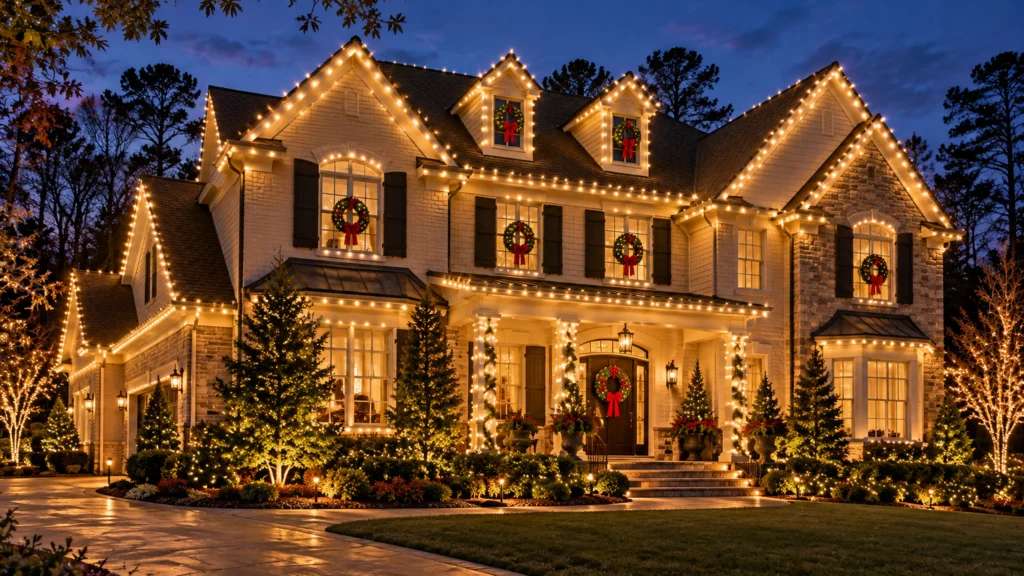
A successful two-story Christmas light design in Atlanta is not simply a one-story layout stretched upward. Upper roof peaks, dormers, columns, and a tall front elevation change where the eye travels after sunset. If every edge receives the same intensity, the house can look visually top-heavy. A better plan establishes one clear architectural outline, then uses lower-level accents to make the entrance feel welcoming.
For a homeowner considering residential Christmas light installation, the first design question is which features are visible from the street. The front elevation might be dramatic, but a steep driveway, large tree canopy, or deep setback can hide some decorative details. A short after-dark viewing walk helps distinguish the details worth lighting from those that add expense without improving the scene.
Create a visual hierarchy between the two floors
Think of the main roof perimeter as the primary outline. A secondary roof, porch eave, or selected upper gable can echo that line without competing with it. The first floor then supplies a visual destination: an illuminated doorway, evenly treated porch columns, or a restrained wreath. This layered approach gives the house depth instead of creating a wall of equally bright points.
A useful test is to stand at the usual viewing distance and identify what your eye notices in the first three seconds. If the highest peak dominates and the front door disappears, shift attention downward. If the first floor looks busy while the upper level feels unfinished, a carefully chosen ridge or dormer may restore balance.
Decide which upper sections deserve illumination
Not every dormer needs to be outlined. On a house with multiple peaks, light the major roof geometry first and treat smaller details as options. Narrow spaces between gables may create overlapping light lines when viewed from the road, especially on angled lots. Some homes benefit from outlining only the front-facing upper perimeter, leaving side elevations unlit.
Review the roofline lighting service for the type of architectural edges that can be included in a scoped installation. The final choice should be based on actual sightlines, mounting surfaces, safe access, and the amount of visible improvement each additional section provides.
Use the entrance to connect height with human scale
A tall facade can feel distant without a lower focal point. Doorway garland, a single properly sized wreath, or consistent porch-column lighting creates a welcoming element people see as they arrive. The entrance should complement the roofline color temperature instead of fighting for attention.
If the front door sits beneath an unusually deep covered porch, bright accents outside the porch and gentler accents within it may read better than identical brightness everywhere. Consider what the scene looks like from the sidewalk, driveway, and front approach rather than only from a straight-on photograph.
Plan access before settling on the final design
Upper-level installation requires a different site review than a straightforward single-story eave. Roof pitch, landscaping, retaining walls, sloping lawns, balconies, and overhead obstructions can complicate access. Avoid assuming that a visually appealing line is automatically reachable or appropriate to decorate.
Read the existing roof and property protection guide when assessing mounting and access decisions. A professional should select suitable methods for the property, avoid unnecessary surface punctures, and postpone elevated work when conditions are unsafe. The scope should distinguish feasible design choices from aspirational sketches.
Consider the display from a long driveway or corner lot
On a deep lot, tiny window outlines may disappear at the road while roofline lighting remains legible. A corner property has more than one viewing angle, but illuminating every side can dilute the budget. Prioritize the approach most people use, then add selective side coverage only when it meaningfully improves the experience.
Use a night photo or a simple annotated image to mark the most visible features. A daytime facade photograph is helpful for layout and measurements; a nighttime view reveals glare, shadow, nearby streetlights, and where existing landscape lighting competes with the Christmas display.
Build a scope that can be quoted and installed consistently
Document the main roof sections, optional peaks, entrance features, preferred colors, desired switch-on window, access restrictions, and whether the display should be visible from a second viewing direction. Ask which materials, in-season repairs, removal, and storage are part of the proposed scope. The full-season service explanation is a useful checklist.
A sensible first version may include the primary upper roofline, one porch feature, and one focal landscape accent. Optional dormers or secondary ridges can be priced separately. This makes the design adaptable without sacrificing its overall visual character.
Common questions about two-story Christmas light design
Should every upper window be outlined?
Usually not. Repetition can look attractive on symmetrical homes, but several small windows may clutter a complex elevation. Start with architecture that reads clearly from the usual viewing distance, then add window accents selectively.
Is a taller home always more expensive to decorate?
Height and access can affect scope, but there is no universal price rule. Roof complexity, the number of lighting zones, materials, and seasonal services matter too. Review Atlanta installation cost factors rather than relying on a generic per-floor estimate.
Can the display be designed without lighting the entire roof?
Yes. A partial but intentional outline often looks better than disconnected lighting added only wherever access seems easy. Choose one coherent main line and supporting entry accents.
Next step for an Atlanta homeowner
Share a clear front-elevation photo, the property address, preferred color approach, and the roof and entry features that matter most. Holiday Illumination can evaluate a property-specific installation scope through its free quote request. A deliberate plan can make a two-story home feel cohesive rather than simply brighter.