
About This Holiday Lighting Guide
Prepared by: Holiday Illumination Christmas Light Installation
Last updated: October 29, 2026
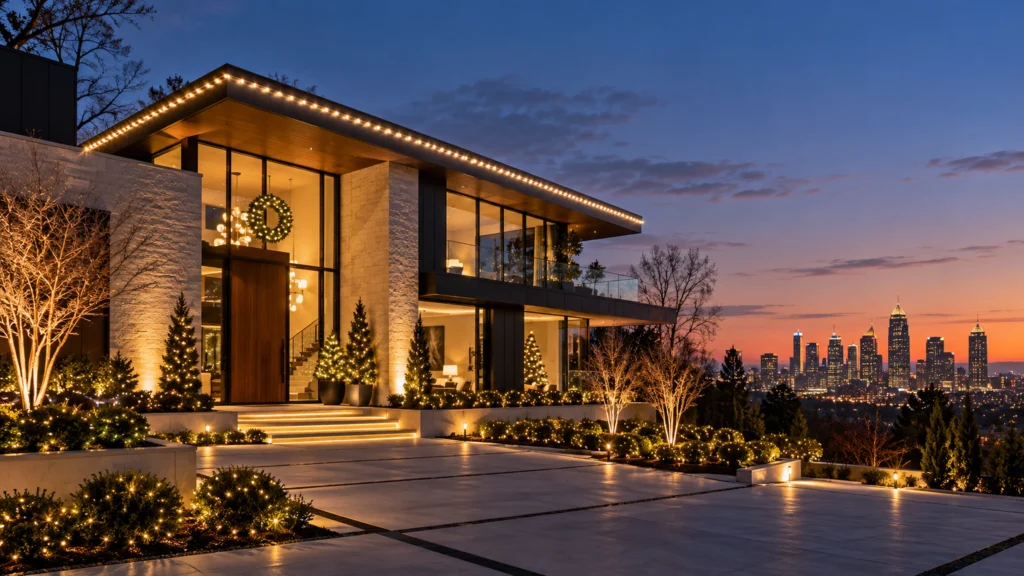
A modern home Christmas light design in Atlanta works best when the lighting respects the building’s geometry. Contemporary homes often rely on flat or low-pitch rooflines, crisp corners, broad windows, and asymmetrical volumes. Traditional decoration can still work, but applying the same pattern to every surface may obscure the design features that make the house distinctive.
Start with the architecture’s strongest lines. A roofline lighting plan can emphasize a major horizontal edge, entry canopy, or contrasting wall volume instead of imitating a steep-gabled suburban display. The goal is to make the house recognizably itself after dark.
Use fewer, longer architectural lines
A contemporary facade may have one dramatic horizontal band that reads clearly from the street. Illuminating that band and a single secondary edge can be more effective than outlining every small projection. Long continuous lines emphasize calm proportions; abrupt fragmented runs can make a precise building appear cluttered.
On asymmetrical homes, do not force mirrored decoration where the structure is intentionally unbalanced. Instead, use the primary roof or canopy line to establish visual order and let a small entrance feature provide the final focal point.
Choose one primary color temperature
Modern materials such as smooth stucco, dark metal, large glass panels, and pale concrete can respond strongly to the color of nearby lamps. Select a dominant color temperature and compare it with the home’s existing exterior fixtures. Cool-looking decorative lights beside very warm wall sconces may create a mismatch even when both are individually attractive.
The warm-white and multicolor comparison is useful for evaluating palette mood. A minimalist design can still use color; the key is giving it a defined role rather than making every architectural line a different hue.
Keep entry decoration refined
A striking contemporary door may need no more than one restrained wreath, narrow vertical accent, or illuminated planter. Dense garland across a clean facade can weaken the sense of proportion. Select decorations that relate to the scale of the door and the lines surrounding it.
Test the entry from both the curb and the pedestrian approach. A small ornament may look almost invisible from the road but feel right up close. The correct scale depends on who will view it and from where.
Use landscaping to soften hard edges
Contemporary architecture often contrasts with natural planting. One illuminated specimen tree or a restrained landscape feature can add warmth without softening every architectural line. Use depth to balance the building rather than filling the entire garden with equal brightness.
Review the tree-wrapping service if a focal tree has an interesting form. A selective trunk and branch treatment can provide a textural counterpoint to straight rooflines and broad glass surfaces.
Consider reflections in glass and polished surfaces
Large windows and smooth facade materials can reflect nearby bulbs intensely. Check whether a decorative line becomes a distraction from inside the living room or blocks outward views. It may be better to shift the location or density of a nearby element than to reduce the overall design’s quality.
Evaluate at night with normal interior and exterior lights in use. Reflections in modern windows can create multiple apparent strings, which may be appealing from one angle and messy from another.
Coordinate the installation with actual surface materials
Mounting options differ across metal edges, flat roof parapets, stucco, wood, and stone. Do not assume clips suitable for one edge will work on every contemporary detail. A professional should evaluate attachment compatibility, access, drainage, and any waterproofing concerns before the design is approved.
The site’s property-protection guide is helpful for questions about surface care and post-season removal. Avoid decisions that depend on unnecessary holes or improvised connections simply to preserve a continuous light line.
Make a minimalist design brief
Pick one main line, one supporting entry or tree feature, and one color direction. Label additional accents optional. Share front and angled facade photos, surface details, and any restrictions related to the roof or building warranty. Request that proposed runs be marked on an image before final approval.
Review the full-season service scope so the minimalist appearance still has a thorough maintenance and removal plan. Simplicity in design should not mean vague responsibilities.
Frequently asked modern-home questions
Are multicolor lights incompatible with modern houses?
No. A restrained single accent color or deliberate programmed scene can work well. The difference is between intentional use and a mix of unrelated effects.
Do flat roofs require a different plan?
They may. Access, parapets, drainage, and suitable attachment points must be evaluated for the particular building rather than treated like a conventional pitched roofline.
Is one illuminated tree enough beside a modern house?
Often. A selected tree can add softness and seasonal character while allowing the architecture to remain the main focus.
Let the architecture lead
Use the free estimate request to share the building’s strongest features and the look you want. Holiday Illumination can evaluate a contemporary display that feels festive without sacrificing the home’s design clarity.